


Updated: October 20, 2026 · By Mark from NaarCuracao
Paying in Curaçao: currency, cards and cash
Good news for travelers from the US and Canada: in Curaçao you rarely need to exchange money. The local currency is the colorful Caribbean guilder, but US dollars are accepted almost everywhere. Here’s everything you need to know about paying in Curaçao: which currency to use, which card to bring, what it costs and how to tip.
At a glance
- The official currency is the Caribbean guilder (XCG or Cg), pegged to the US dollar at a fixed rate of Cg 1.79 = US$ 1.
- US dollars are accepted almost everywhere: in taxis, shops, restaurants and beach bars. Change is usually given in guilders.
- Credit cards (Visa and Mastercard) work nearly everywhere; American Express is accepted less often.
- Use a card with no foreign transaction fee and always choose to pay in guilders (XCG), never in your home currency.
- Canadian dollars are not accepted. Bring some small US bills for taxis and tips.
The Caribbean guilder: Curaçao’s currency
Since March 31, 2025, the official currency of Curaçao is the Caribbean guilder, abbreviated XCG or Cg (in Papiamentu: florin karibense). It replaced the Netherlands Antillean guilder and is also used on Sint Maarten. The guilder is pegged to the US dollar at a fixed rate of Cg 1.79 = US$ 1, so one guilder is worth about 56 US cents.
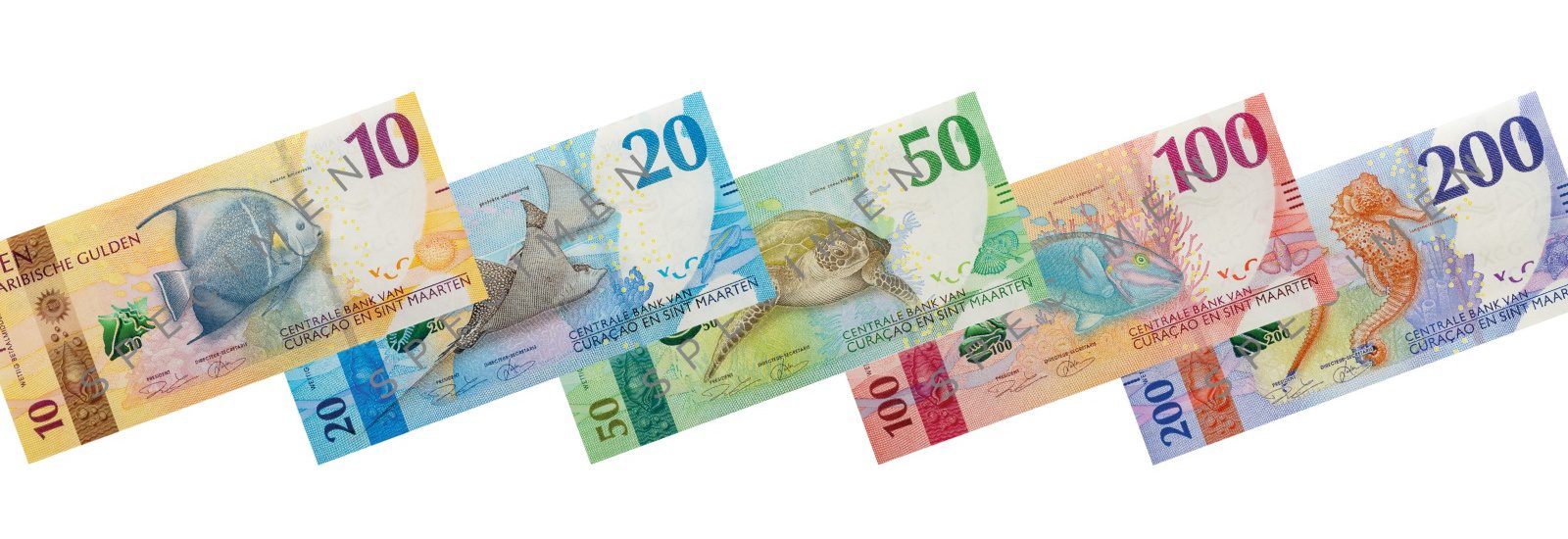
There are bills of Cg 10, 20, 50, 100 and 200, each showing sea life such as an angelfish, an eagle ray, a sea turtle, a parrotfish and a seahorse. Coins come in 1, 5, 10, 25 and 50 cents, and 1 and 5 guilders.
Quick math: guilders to dollars
To convert a price in guilders to US dollars in your head, divide by 2 and add about 10%. A Cg 40 lunch is roughly US$ 22. Or use the converter below.
Enter an amount to see what it costs in US dollars.
Can you use US dollars in Curaçao?
Yes. Because the guilder is pegged to the dollar, US dollars are accepted almost everywhere in Curaçao: in taxis, supermarkets, restaurants, beach bars and souvenir shops. In tourist areas such as Punda, Otrobanda and the cruise terminal, many menus and price lists are in dollars anyway.
- Exchange rate: when you pay cash in dollars, shops often use Cg 1.75 = US$ 1 instead of the official 1.79. That’s about 2% in their favor, which is usually fine for small purchases.
- Change in guilders: you’ll usually get your change in guilders. Spend those coins and bills before you leave, as you can’t easily exchange them back at home.
- Check the currency: some restaurants list prices in guilders, others in dollars. Ask if you’re not sure, as the difference is almost a factor two.
- Bring small bills: US$ 1, 5, 10 and 20 bills are the most useful. Large bills (US$ 50 and 100) are sometimes refused for small amounts.
Canadian dollars and other currencies
Canadian dollars, euros and other currencies are not accepted in Curaçao. Exchanging them is only possible at a local bank (bring your passport), and there are no exchange booths where you can just walk in. Coming from Canada? Get some US dollars before you leave, or simply pay by card.
Visiting other islands?
The Caribbean guilder is only used on Curaçao and Sint Maarten. Aruba uses the Aruban florin, and Bonaire, Sint Eustatius and Saba use the US dollar. US dollars work on all of them.
Credit card, debit card or cash?
Most places in Curaçao accept cards, including supermarkets, restaurants and beach bars. You’ll need cash for taxis, small local businesses, food trucks, market stalls and tips. This is how the options compare:
| Payment method | Where to use it | Extra costs | Our advice |
|---|---|---|---|
| Credit card (Visa, Mastercard) | Almost everywhere | 0% with a no-foreign-fee card; up to 3% on many US cards, usually 2.5% on Canadian cards | Best option for most purchases |
| American Express | Hotels and larger restaurants; less elsewhere | Depends on your card | Always bring a Visa or Mastercard as well |
| Debit card | Almost everywhere, and at ATMs | Foreign transaction fee and ATM fees from your bank | Mainly for cash withdrawals |
| Cash US dollars | Almost everywhere | Often Cg 1.75 instead of 1.79; change in guilders | Ideal for taxis, tips and small purchases |
| Cash guilders | Everywhere | ATM fees when you withdraw | Handy, but not essential for most visitors |
Always pay in guilders (XCG), not in US or Canadian dollars
Card terminals and ATMs sometimes ask if you want to pay in your home currency. Always choose guilders (XCG). If you pick dollars, the local bank converts the amount at its own, much worse rate. This is called dynamic currency conversion, and it can easily cost you 5 to 10% extra. Your own card’s conversion is almost always cheaper.
Using your cards and ATMs in Curaçao
Choose a card without foreign transaction fees
Many US credit cards charge a foreign transaction fee of up to 3% on every purchase abroad, and most Canadian cards charge 2.5%. Plenty of travel credit cards charge no foreign transaction fee at all. Check your cards before you travel; on a one-week trip the difference can easily add up to US$ 50 or more.
Let your bank know you’re traveling if your card issuer requires it, and save its international phone number in case your card gets blocked.
Withdrawing cash from an ATM
You’ll find ATMs at banks, supermarkets and shopping malls. Most dispense both guilders and US dollars. Withdrawing cash is expensive, though: the local bank charges a fixed fee of at least Cg 10 (about US$ 6) per withdrawal, and your own bank usually adds an out-of-network fee and a foreign transaction fee. Withdraw a larger amount once instead of several small amounts.
The ATM in the arrivals hall at Hato Airport (Curaçao International Airport, CUR) is often out of order, so don’t count on it.
Paying for car rental
To rent a car in Curaçao you’ll usually need a credit card in the driver’s name for the security deposit. The deposit is only reserved on your card. Read more about renting a car in Curaçao.
Tipping in Curaçao
Tipping in Curaçao is appreciated but more modest than in the US. Many restaurants already add a service charge of 10 to 15% to the bill, so check your receipt before you tip. If service isn’t included, 10 to 15% is customary. In a taxi, round up the fare or give about 10%. For porters, housekeeping and your tour guide, a few dollars is a nice gesture. Tips are easiest in cash, in dollars or guilders.
Old Netherlands Antillean guilders
Until March 31, 2025, Curaçao used the Netherlands Antillean guilder (ANG or NAf). Since July 1, 2025, you can no longer pay with it. Since April 1, 2026, old guilders can only be exchanged at the Central Bank of Curaçao and Sint Maarten in Willemstad, until March 31, 2055.
Old or new? Birds or fish!
It’s easy to tell old and new bills apart. The old Antillean guilder bills show a bird. The new Caribbean guilder bills show sea life.
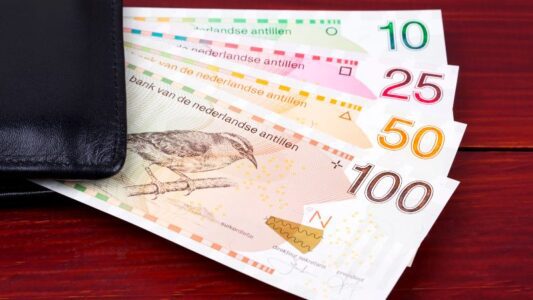
Still have old NAf from a previous trip? Make some dogs happy!
Donate your leftover Antillean guilders to Rescue Paws Curaçao, a local shelter for stray dogs. You can drop them off in Curaçao:
– at Remax Eden Mall (please use an envelope marked ‘Anita’),
– at pet store Dommelsche Watermolen,
– at several veterinary clinics.

Paying for your airport taxi and excursions
Airport taxi
Taxis in Curaçao are paid in cash, in US dollars or guilders; cards are usually not accepted. A ride from Hato Airport to your hotel starts at US$ 35 (Cg 63). Book your airport transfer with NaarCuracao: you pay a deposit of online and the rest in cash to our regular driver Norwin, who meets you in the arrivals hall.
Excursions
Book your excursions online with NaarCuracao. You pay a deposit online and the rest to the tour operator in Curaçao. Each excursion page shows which payment methods the operator accepts.
Frequently asked questions about money in Curaçao
What currency is used in Curaçao?
Curaçao uses the Caribbean guilder (XCG or Cg) since March 31, 2025. It is pegged to the US dollar at a fixed rate of Cg 1.79 = US$ 1.
Can I use US dollars in Curaçao?
Yes. US dollars are accepted almost everywhere, including taxis, shops and restaurants. Many places use a rate of Cg 1.75 = US$ 1 for cash dollars, and change is usually given in guilders.
Do I need to exchange money before going to Curaçao?
Not if you’re from the US. Bring some small US bills for taxis and tips and pay by card for the rest. Travelers from Canada should bring US dollars, because Canadian dollars are not accepted.
Are credit cards accepted in Curaçao?
Yes, Visa and Mastercard are accepted almost everywhere. American Express is accepted less often. Use a card without foreign transaction fees and always choose to pay in guilders (XCG).
What do ATMs in Curaçao charge?
Local banks charge a fixed fee of at least Cg 10 (about US$ 6) per withdrawal, and your own bank usually adds its own fees. Most ATMs dispense both guilders and US dollars.
How much should I tip in Curaçao?
Many restaurants already include a 10 to 15% service charge. If it isn’t included, 10 to 15% is customary. In a taxi, round up or tip about 10%.
Can I pay for a taxi in Curaçao by card?
Usually not. Taxis in Curaçao are paid in cash, in US dollars or guilders. A ride from the airport to your hotel starts at about US$ 35.
What can I do with old Antillean guilders?
Since April 1, 2026, old Netherlands Antillean guilders can only be exchanged at the Central Bank of Curaçao and Sint Maarten, until March 31, 2055. You can also donate them to the dog shelter Rescue Paws Curaçao.